Java Persistence API (JPA) ~ Part 2 ~ Entity Manager
The entity manager API is used to create and remove entity instances, find entities by their primary key and to query entities.
JPA defines a persistence unit in the persistence.xml file which caters for:
- Caching
- Allowable operations
- Datasource
- Additional settings
From Spring 3.1, the persistence XML is not necessary because Spring scans the packages for all entities.
The LocalContainerEntityManagerFactoryBean supports a packagesToScan property.
The EntityManager supports database CRUD operations to persist objects to the database.
| Method | Description |
| getTransaction() | Return the resource-level EntityTransaction object |
| persist(Object entity) | Make an instance managed and persistent |
| remove(Object entity) | Remove the entity instance |
| refresh(Object entity) | Refresh the state of the instance from the database, overwriting changes made to the entity, if any |
| find(Class<T> entityClass, Object primaryKey) | Find by primary key |
| createQuery(CriteriaDelete deleteQuery) | Create an instance of Query for executing a criteria delete query |
| flush() | Synchronize the persistence context to the underlying database |
The relationship between JPA components:
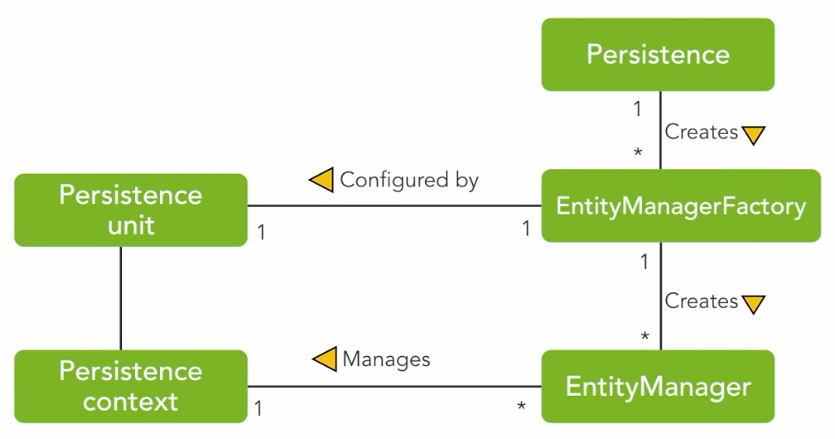
Entities are considered to be in a managed state when managed by the EntityManager and until it is managed by the EntityManager it is just a POJO in a detached state.
This class uses JPA annotations without any Spring dependencies.
- The @PersistenceContext annotation injects the EntityManager into the DAO class
- By adding a single bean definition, the Spring container will act as a JPA container and inject an EntityManager from the EntityManagerFactory
- This approach uses a transactional EntityManager, considered a shared EntityManager which is preferred to avoid creating a new EntityManager every time an operation has to be performed through the EntityManagerFactory.
- This approach creates a shared thread-safe proxy, allowing the actual TransactionEntityManager to be injected instead of the factory.
- The @PersistenceContext annotation has an optional attribute type property which defaults to PersistenceContextType.TRANSACTION which is required to receive a shared EntityManager proxy.
@Transactional
@Repository
public class ApplicationDAO implements IApplicationDAO {

   @PersistenceContext
   private EntityManager entityManager;

   @Override
   public void addApplication(Application application) {
       entityManager.persist(application);
   }

   @Override
   public Application getApplicationById(int applicationId) {
       return entityManager.find(Application.class, applicationId);
   }